

FireFly Metals turns Green Bay growth into development story in Canada
Published: 12:05 22 Sep 2026 AEST

FireFly Metals Ltd (ASX:FFM, TSX:FFM, OTC:FFMFF) spent 2026 turning Green Bay from a fast-growing copper discovery into a credible development proposition, backed by a larger high-grade resource, robust economics and an increasingly clear pathway towards production.
The year was dominated by an aggressive underground drilling campaign at the Green Bay Copper-Gold Project in Newfoundland and Labrador, Canada, where FireFly continued to expand and upgrade the Ming deposit while advancing permitting, technical studies and project development.
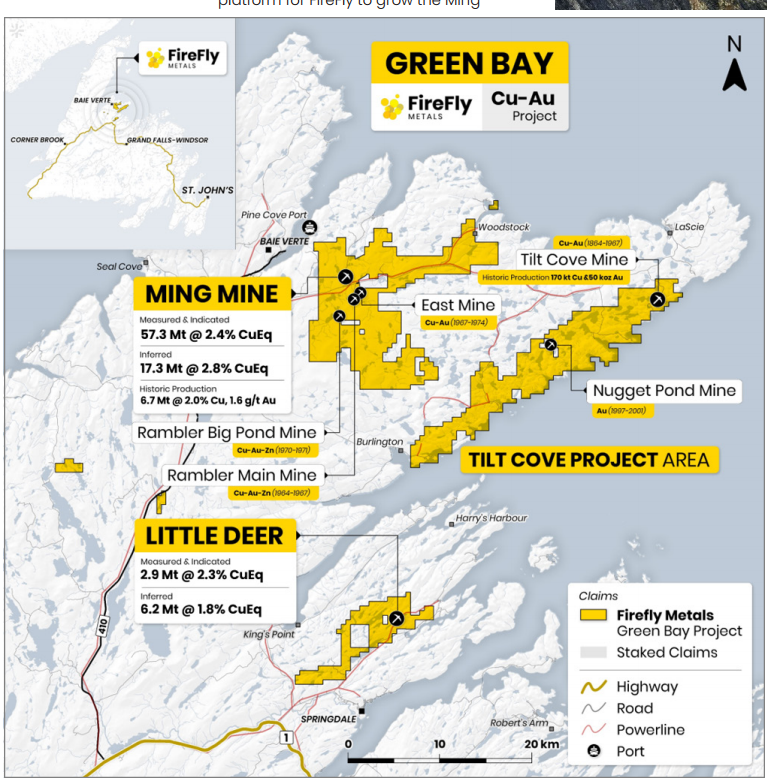
FireFly Metals Green Bay Project overview
By August 2026, Green Bay hosted 60.2 million tonnes of measured and indicated resources at 2.4% copper equivalent (CuEq) for 1.464 million tonnes of contained CuEq, alongside 23.5 million tonnes of inferred resources at 2.5% CuEq for a further 592,000 tonnes.
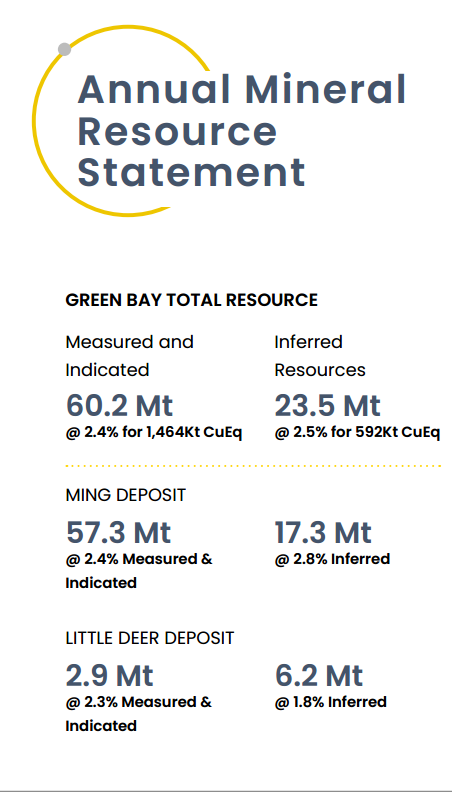
The latest estimate represented another step-change in confidence as well as scale. FireFly said measured and indicated tonnes increased 19% from the November 2025 resource, driven by extensive infill drilling and conversion of higher-grade VMS and core-zone mineralisation.
High-grade core takes shape
Central to the Green Bay story has been the definition of a high-grade core within Ming.
The August resource included 18.1 million tonnes at 4.3% CuEq in measured and indicated resources and a further 7.0 million tonnes at 4.4% CuEq inferred.
Continued drilling has extended the zone and reinforced its continuity, with results including 42 metres at 6.1% CuEq and 9.8 metres at 16.5% CuEq. FireFly believes this higher-grade material has the potential to strengthen the early years of a future production profile.
The scale of the drilling program has been substantial.
Since drilling resumed following the Green Bay acquisition in October 2023, FireFly has completed 1,334 underground holes for about 197,700 metres by June 30, 2026, with up to six underground rigs operating during the financial year.
The campaign has served two purposes: extending mineralisation beyond the historic mine footprint and converting inferred resources into the higher-confidence categories required for future mine planning.
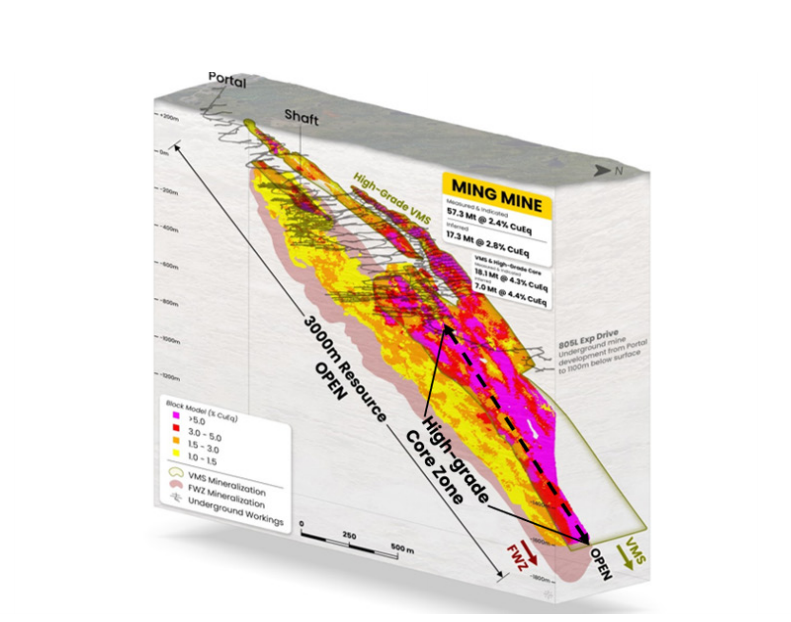
The upper high-grade copper-gold massive sulphide lenses showed strong continuity beyond the extent of historical
mining.
Economics put development in focus
The geological work was followed by another important milestone after year-end when FireFly released the preliminary economic assessment for Ming on August 25.
The study outlined a base-case 1.8-million-tonne-per-annum development with an after-tax net present value of about A$2.2 billion and an internal rate of return of 41%.
It also identified an expansion case based on a 4.6-million-tonne-per-annum operation capable of producing roughly 100,000 tonnes of copper equivalent a year.
The economics are supported by a significant amount of infrastructure already in place.
The historic Ming mine has an operational decline reaching about 950 metres below surface and a 650-metre-deep shaft. FireFly estimates there is around A$250 million of existing mine infrastructure, providing a platform for both continued drilling and a potential future restart.
Green Bay also benefits from established regional infrastructure including paved roads, access to hydroelectric power and proximity to the Pine Cove deep-water port, around 10 kilometres from the project.
Permitting moves alongside drilling
FireFly also made headway on the approvals required to move Green Bay towards construction.
During 2026, the Newfoundland and Labrador Government accepted the company's water resources management and environmental protection plans and confirmed that several outstanding environmental assessment conditions had been met.
The approved expansion concept allows for underground production to increase from 1,250 tonnes to 4,800 tonnes per day and includes a new processing plant, tailings facility, haul roads, transmission lines and other supporting infrastructure.
Metallurgical testing has provided another encouraging piece of the development picture.
Bulk samples covering both the high-grade copper-gold VMS mineralisation and broader Footwall Zone delivered copper recoveries of more than 98% and gold recoveries above 85%.
FireFly is also examining how the region's power mix could support a lower-emissions operation. The project is connected to Newfoundland and Labrador Hydro's grid, which the annual report says derives more than 90% of its electricity from renewable sources, primarily hydroelectric generation.
Sharper focus on Green Bay
The growing importance of Green Bay also prompted FireFly to simplify its wider portfolio.
During the year, the company sold its Ontario gold assets, including Pickle Crow and Sioux Lookout, to Bellavista Resources Ltd, with the transaction completed in April.
FireFly said the move allowed it to unlock value from the gold portfolio while concentrating its efforts on Green Bay. Eligible FireFly shareholders subsequently received Bellavista shares through an in-specie distribution.
The company also finished June with A$184 million in cash before undertaking a further A$180 million equity raising after year-end to fund continued resource growth and development activities.
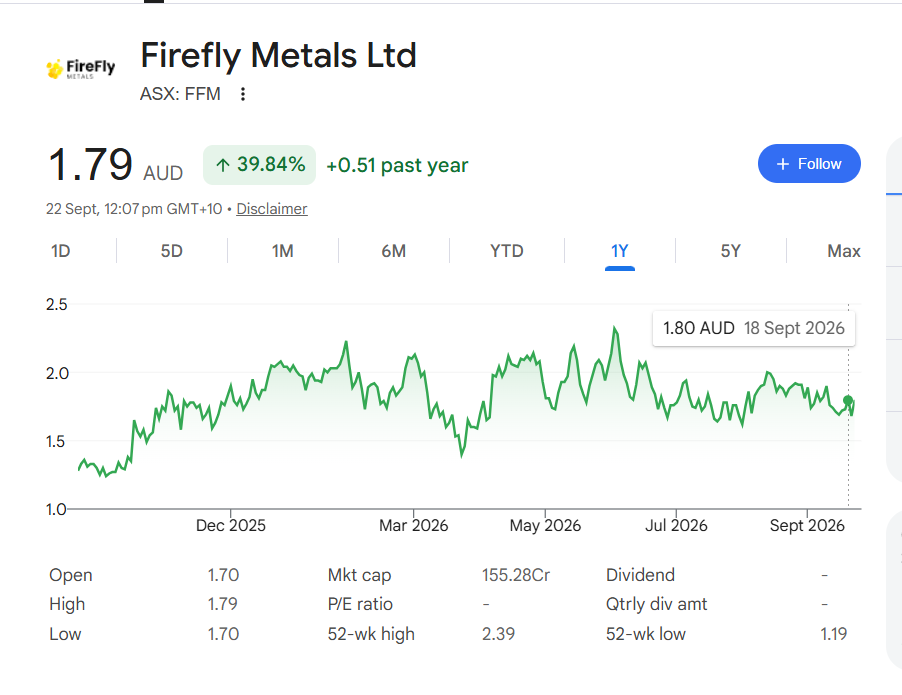
The progress was reflected in FireFly's market profile. Its annual report recorded a 69% increase in the share price to A$1.76 and a 102% increase in market capitalisation to around A$1.4 billion, while the company entered the S&P/ASX 200 Index in June 2026.
From resource growth to execution
FireFly enters the next phase with a substantially larger resource, a defined high-grade core, encouraging economics and a strengthened balance sheet.
Drilling will continue, both underground and across the broader Green Bay district, but the centre of gravity is increasingly shifting towards mine development.
The company plans to advance a definitive feasibility study and ultimately put a final investment decision before the board as it works towards developing Green Bay into a producing operation.
The next year will therefore be less about establishing whether Green Bay has scale and more about demonstrating how that scale can be converted into a mine.


