Lumos Diagnostics builds US commercial momentum as FebriDx rollout accelerates
Last updated: 11:44 13 Nov 2026 AEDT, First published: 11:05 13 Nov 2026 AEDT

Lumos Diagnostics Holdings Ltd (ASX:LDX, OTC:LDXHF) is entering a key commercial phase in the US, as adoption of its FebriDx point-of-care diagnostic test accelerates across urgent care and primary care networks.
The company has spent the past several years building the regulatory, reimbursement, distribution and manufacturing foundations needed to commercialise FebriDx at scale.
With those pieces now largely in place, FY27 is shaping up as an execution year focused on converting healthcare sites, increasing utilisation and growing recurring product revenue.
Lumos develops, manufactures, and distributes point-of-care diagnostic products designed to give clinicians actionable information in real time. FebriDx has become the central driver of its US commercial strategy.
FebriDx targets a major clinical need
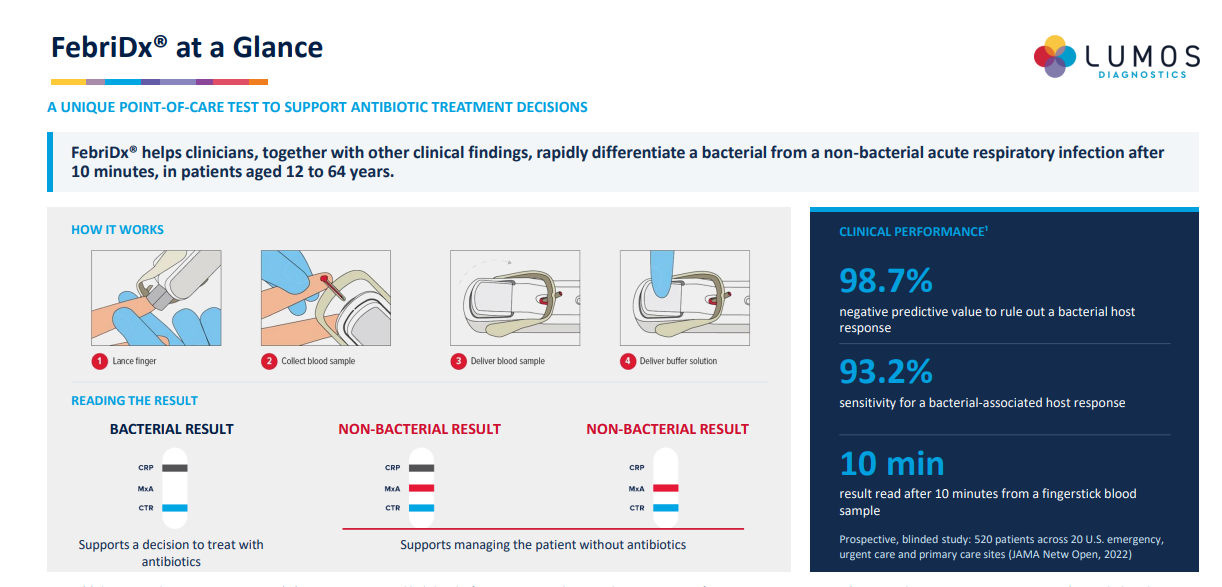
FebriDx is a rapid fingerstick blood test designed to help clinicians distinguish between a bacterial-associated host response and a non-bacterial acute respiratory infection, with results available in around 10 minutes.
That distinction is important because clinicians routinely need to decide whether antibiotics are likely to be appropriate for patients presenting with respiratory symptoms.
Lumos reports that FebriDx has a 98.7% negative predictive value for ruling out a bacterial host response and 93.2% sensitivity for a bacterial-associated host response.
Those figures are based on a prospective US study involving 520 patients across 20 emergency, urgent care and primary care sites.
The product becomes particularly relevant during the US respiratory season, when acute respiratory infections increase and clinicians face a higher volume of antibiotic treatment decisions.
Lumos points to research suggesting around half of antibiotic prescriptions for acute respiratory infections may be unnecessary. FebriDx is designed to support that decision-making process rather than identify the specific pathogen involved.
Regulatory and reimbursement foundations are in place
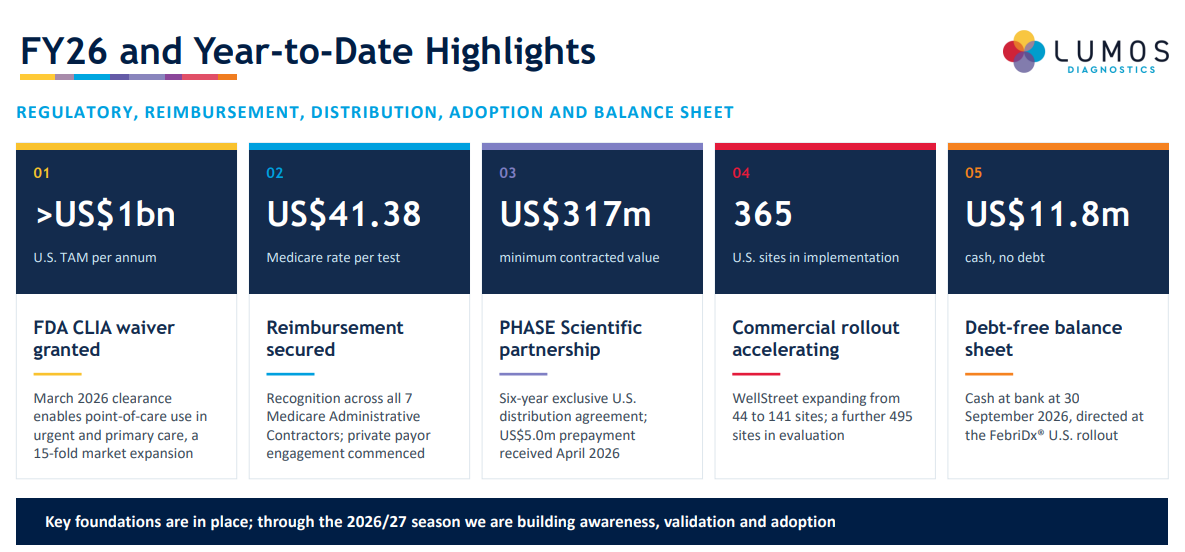
A major milestone came in March 2026, when FebriDx received a US FDA CLIA waiver.
That clearance allowed broader point-of-care use in urgent care and primary care settings and, according to Lumos, expanded the addressable US market around 15-fold.
The company estimates the annual US market opportunity at more than US$1 billion.
Reimbursement has also progressed. FebriDx has secured a Medicare rate of US$41.38 per test across all seven Medicare Administrative Contractors, while Lumos has started engaging with private payers.
On distribution, Lumos has entered a six-year exclusive US agreement with PHASE Scientific carrying a minimum contracted value of US$317 million.
The agreement also included a US$5 million prepayment, which Lumos received in April 2026.
Together, those milestones give Lumos a clearer commercial path than it had even a year ago.
The next challenge is getting FebriDx embedded into clinical workflows and used consistently across larger healthcare networks.
WellStreet demonstrates the scale-up model
WellStreet Urgent Care has become one of the clearest examples of how Lumos wants that rollout to work.
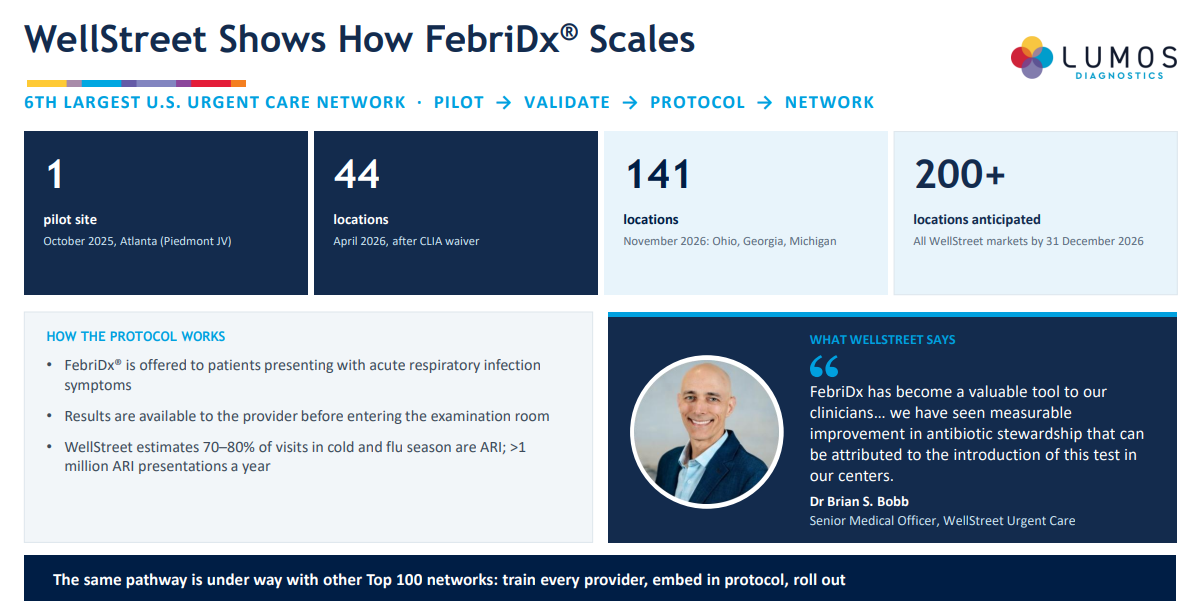
The relationship began with a single pilot site in Atlanta in October 2025, before expanding to 44 locations following the CLIA waiver.
By November 2026, FebriDx had reached 141 WellStreet locations across Ohio, Georgia and Michigan.
Lumos expects rollout across all 200-plus WellStreet locations by December 31, 2026.
That expansion is important because WellStreet estimates that 70% to 80% of visits during the cold and flu season involve acute respiratory infection symptoms.
That represents more than one million respiratory presentations a year.
FebriDx is also being incorporated into WellStreet's triage protocols, giving the test a pathway to recurring rather than occasional use.
WellStreet senior medical officer Dr Brian S. Bobb said the network had seen “measurable improvement in antibiotic stewardship” following the introduction of FebriDx.
For Lumos, the WellStreet rollout is more than one customer win.
It provides a template the company can attempt to replicate across other large urgent care groups: pilot the product, demonstrate clinical value, embed it in protocol and then expand it across the network.
US site growth is accelerating
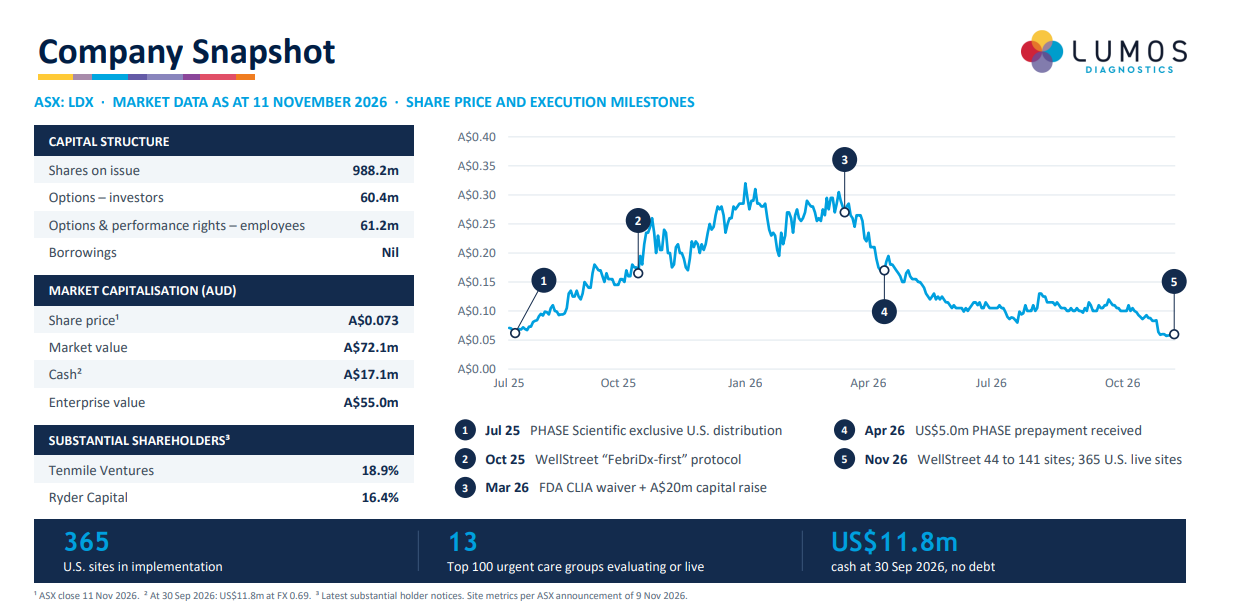
Lumos had 365 US sites on implementation by November 9, up from 170 sites in late July.
Another 495 sites were in evaluation, although the company cautions that not all evaluation sites will necessarily convert.
Five of the Top 100 US urgent care groups already had live sites, while another eight were evaluating FebriDx.
The implemented sites are estimated to represent between 1.5 million and 2 million acute respiratory infection visits a year.
The evaluation pipeline could represent another 2 million to 2.7 million visits annually.
That is why Lumos is focusing heavily on large urgent care operators.
The Top 100 groups collectively account for around 5,722 sites, meaning one network-level decision can potentially move dozens or even hundreds of locations at once.
Primary care is also beginning to emerge as a meaningful opportunity.
A Northeast US primary care network involving more than 300 providers has moved into full deployment, giving Lumos another channel beyond urgent care.
Revenue is starting to follow adoption
The improving commercial position is beginning to show in Lumos' financial performance.
FY26 revenue rose 6% to US$13.2 million, while FebriDx revenue increased 875% year on year.
Gross profit reached US$7.9 million at a gross margin of 60.1%.
The adjusted EBITDA loss narrowed by 18% to US$2.8 million from US$3.4 million in FY25.
Momentum has continued into FY27.
Product revenue for the September quarter reached US$560,000, up 224% from US$170,000 in the previous corresponding period.
Lumos finished September with US$11.8 million in cash and no debt, giving the company funding to continue the US rollout through the key respiratory season.
The company remains cash flow negative, so investors will be watching closely to see whether higher site numbers translate into rising test volumes and stronger recurring revenue.
Manufacturing positioned for growth
Lumos manufactures FebriDx in-house in Carlsbad, California, rather than outsourcing production.
That gives the company control over cost, quality and supply.
The company says product gross margins are above 60% at launch.
A new ISO 13485-certified Carlsbad facility is scheduled to open by the end of calendar 2026.
Once validated, the facility is expected to support annual production capacity of up to 10 million tests.
Lumos also says its current facility has enough capacity to cover more than two years of forecast volume.
That means the company is expanding manufacturing ahead of expected demand rather than reacting after capacity becomes constrained.
Paediatric opportunity offers further upside
Lumos is also progressing a BARDA-funded US study in children aged two to 12.
Around 400 patients have been enrolled, while three additional hospital emergency departments are being added to help increase recruitment and bacterial-positive cases.
Lumos has received US$2.6 million of up to US$6.2 million in non-dilutive BARDA funding.
The company estimates that a successful paediatric indication could expand the US market opportunity by 15% to 20%.
However, enrolment and bacterial-positive cases have been below the original study plan.
Lumos expects to discuss the study with BARDA and the FDA by the end of calendar 2026, including whether revised parameters could allow the statistical endpoint to be reached.
No change has yet been agreed.
Importantly, the paediatric program does not affect the existing commercialisation of FebriDx in patients aged 12 to 64.
FY27 becomes the execution year
The next phase of the Lumos story is less about regulatory approval and more about commercial conversion.
The company is targeting more than 7,100 clinical and operational decision-makers across the Top 100 urgent care groups.
At the same time, it is working to move more evaluation sites into live deployment and replicate the protocol-driven model established with WellStreet.
Several near-term catalysts could provide a clearer picture of how that strategy is progressing.
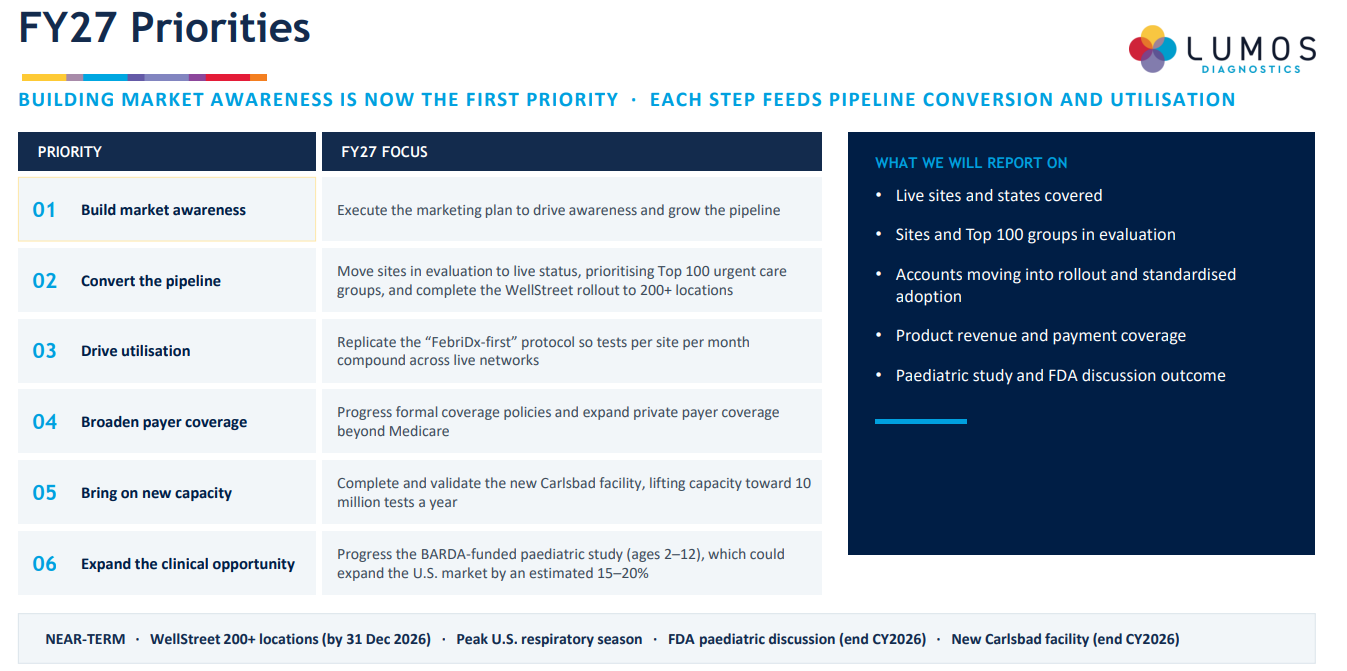
These include completing the WellStreet rollout to more than 200 sites, converting more Top 100 urgent care groups, increasing utilisation through the peak US respiratory season and validating the new Carlsbad manufacturing facility.
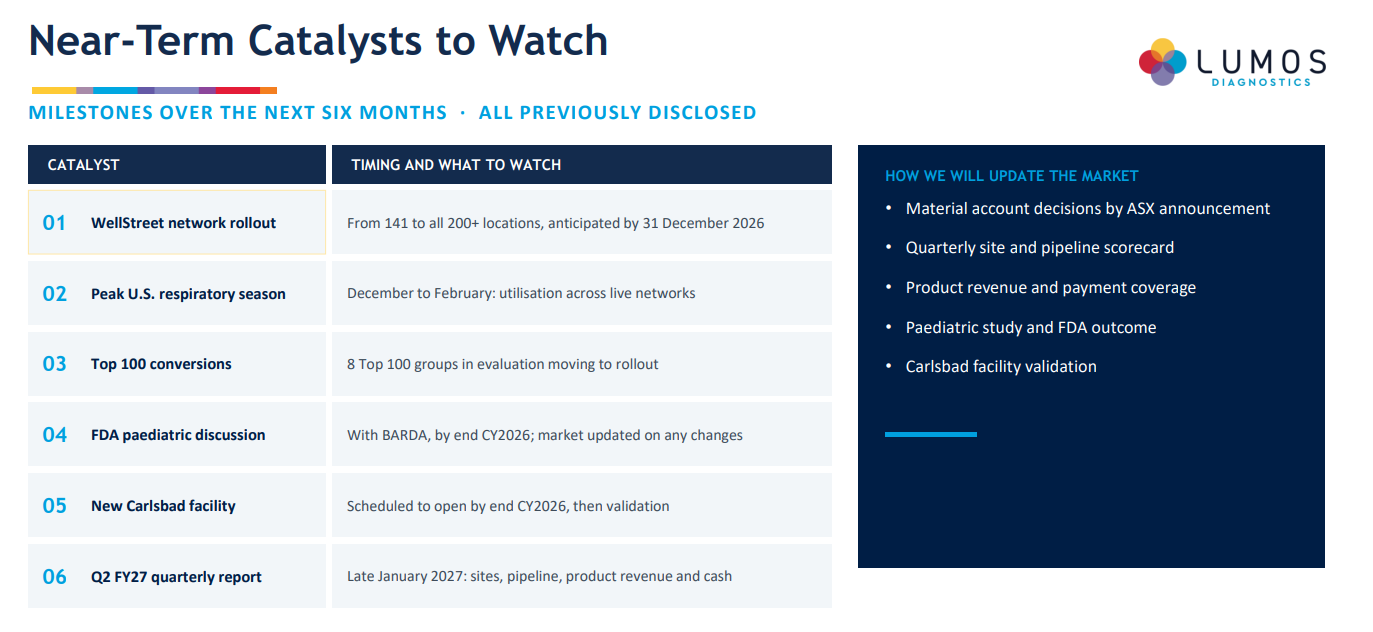
Lumos also plans to broaden payer coverage and update the market on its discussions with the FDA and BARDA regarding the paediatric program.
The company has identified six priorities for FY27: build market awareness, convert the pipeline, drive utilisation, broaden payer coverage, expand manufacturing capacity and progress the paediatric opportunity.
For investors, utilisation is likely to become the key measure.
The rising number of sites shows Lumos is gaining access to larger healthcare networks.
The bigger question is how frequently FebriDx is used once it becomes embedded in routine clinical practice.
If utilisation rises alongside the site rollout, Lumos could begin converting years of regulatory and commercial groundwork into a much larger US diagnostics business.