

Novo Resources confirms major hydrothermal system at Wyloo with high-grade silver-antimony hit
Last updated: 20:19 21 Jul 2026 EDT, First published: 19:56 21 Jul 2026 EDT

Novo Resources Corp (TSX:NVO, OTCQX:NSRPF, ASX:NVO, FRA:1NOR) has confirmed a significant hydrothermal alteration system at its Wyloo Polymetallic Project in Western Australia’s Pilbara, following maiden reverse circulation drilling that returned high-grade silver and antimony mineralisation from surface.
The 16-hole, 2,615-metre program at the Wyloo SE prospect delivered a standout intercept of 9 metres at 92 g/t silver and 1,280 ppm antimony from surface, including 1 metre at 460 g/t silver and 1,425 ppm antimony from 2 metres.
Drilling also encountered broad zinc mineralisation, including 3 metres at 3.6% zinc, with a peak one-metre assay of 6.5% zinc, within a wider 27-metre mineralised halo.
Drilling validates Wyloo exploration model
The program tested mapped quartz-sulphide veining and the northeast-southwest-trending Tasha Fault Zone across seven drill sections.
Novo identified strong sericite and chlorite alteration zones of up to 20 metres thick, accompanied by sulphide mineralisation and highly anomalous arsenic.
Silver, antimony and zinc mineralisation has now been recorded across a 230-metre strike length, supporting the company’s interpretation that Wyloo SE forms part of a broader mineralised system rather than an isolated occurrence.
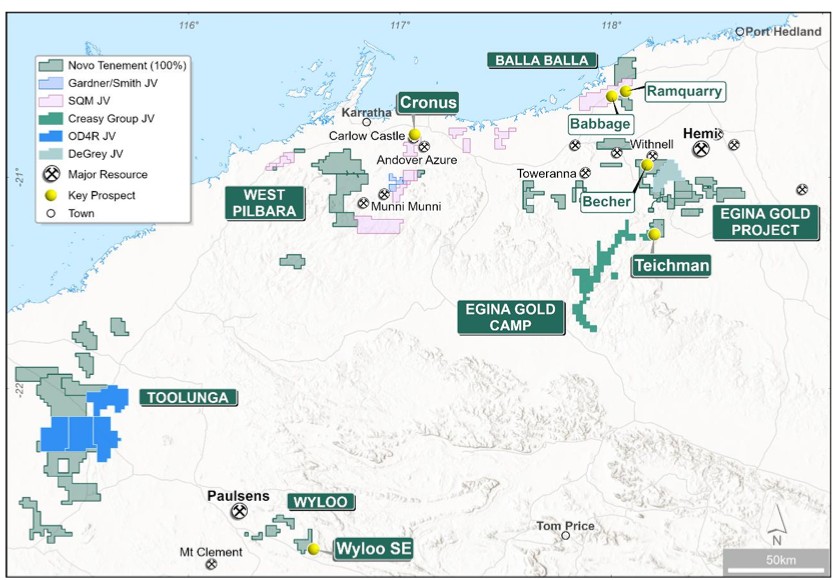
Novo Pilbara and Onslow District tenure showing significant prospects and location of the Wyloo Project in the southern Pilbara.
Vera anomaly expands project footprint
Surface sampling southeast of the drilling has also identified the Vera prospect, where a coherent antimony-arsenic soil anomaly extends for about 600 metres and is up to 270 metres wide.
Peak soil assays returned 803 ppm antimony and 1,265 ppm arsenic, while rock-chip sampling produced results of up to 3.5% antimony, 33.2 g/t silver, 1.4% zinc and 2.1% lead.
Novo said the anomaly remains open to the north and east, significantly extending the prospective footprint beyond the current Wyloo SE drilling area.
The nearby Kavira prospect is another priority, hosting a 2.5-kilometre by 800-metre antimony stream-sediment anomaly beneath extensive transported cover.
Toolunga project expanded around IOCG targets
Novo has also increased its Toolunga Copper-Gold Project footprint from 1,520 square kilometres to 2,242 square kilometres through new tenement applications and optioned ground.
Reprocessed magnetic and gravity datasets have defined three high-priority iron oxide copper-gold-style targets at Lobster, Ironstone Bore and Mount Minnie.
The Lobster target covers an 8-kilometre by 4-kilometre magnetic-gravity complex, while Ironstone Bore contains an untested 2.5-kilometre by 2-kilometre anomaly. Mount Minnie hosts coincident geophysical targets and historical rock-chip results of up to 755 ppm copper.
Next steps
Novo is undertaking hyperspectral analysis and geological modelling at Wyloo SE to identify vectors for follow-up drilling.
Further mapping, soil sampling and rock-chip work is planned at Vera during the third quarter of 2026, while an aircore drilling program at Kavira is targeted for the fourth quarter, subject to approvals.
At Toolunga, fieldwork will begin after the relevant tenements are granted, including ground gravity surveys, geochemical sampling and 3D modelling ahead of potential RC drilling.
Seven assay results from the company’s separate Cronus gold drilling program also remain pending, with results expected shortly.