


Actinogen Medical targets Alzheimer’s treatment gap in projected $20BN market
Published: 21:50 04 Aug 2026 EDT

Actinogen Medical Ltd (ASX:ACW, OTC:ATGGF) is approaching a defining clinical milestone as it advances Xanamem, a once-daily oral therapy designed to slow Alzheimer’s disease by controlling elevated cortisol in the brain.
The company’s fully enrolled XanaMIA Phase 2b/3 trial is expected to report topline results in November 2026, providing the most important test yet of whether Xanamem can deliver a meaningful benefit in patients with mild-to-moderate Alzheimer’s disease.
Actinogen is positioning the treatment as a potentially simpler and more broadly usable alternative to existing anti-amyloid therapies, which can require infusions, regular brain imaging and careful management of amyloid-related imaging abnormalities, or ARIA.
Xanamem has been developed as an oral, once-daily tablet and has shown no ARIA signal in clinical testing to date. Actinogen says no serious adverse events related to the drug have been reported across a clinical program involving about 500 participants.
Commercial and strategic highlights
- Experienced leadership team with expertise across clinical development, regulatory approval, commercialisation and strategic transactions.
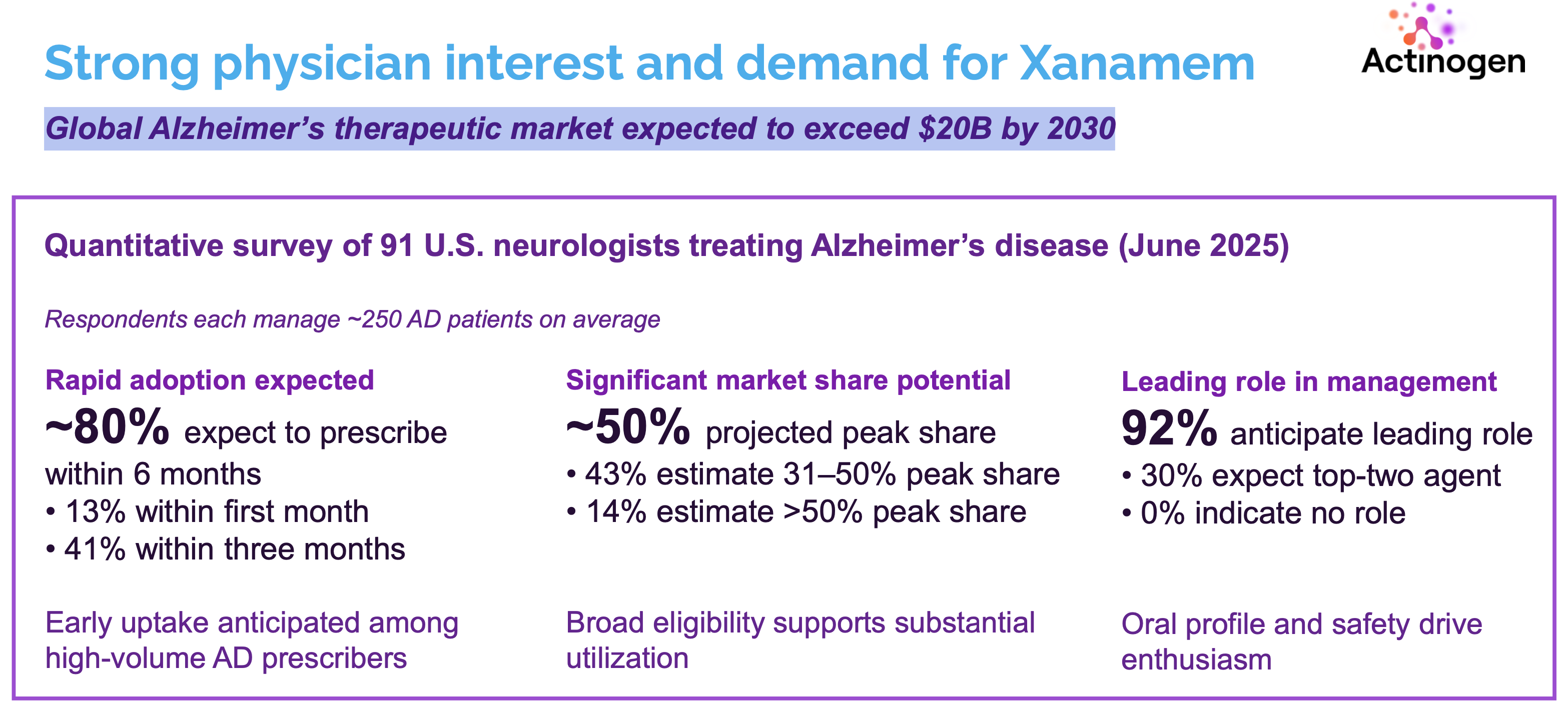
- Strong physician interest in Xanamem, with around 80% of surveyed US neurologists indicating an intention to prescribe the treatment within six months of launch.
- Xanamem’s observed antidepressant activity could strengthen its potential prescribing profile in Alzheimer’s disease.
- Composition-of-matter patent protection extends to 2036 in most markets, with additional patents potentially providing protection into the 2040s.
- Regulatory data exclusivity of at least five to six years from marketing approval could provide further protection against generic competition in major markets.
- Strategic interest and engagement are increasing ahead of the XanaMIA topline results.
- Actinogen is funded into 2027, extending beyond the pivotal Alzheimer’s disease readout.
Alzheimer’s market still carries major unmet need
Actinogen is operating in a global Alzheimer’s therapeutics market the company expects to exceed US$20 billion by 2030.
Recent anti-amyloid treatments have represented an important advance, but the company argues they only modestly slow cognitive and functional decline and remain limited by intravenous or subcutaneous administration, safety monitoring requirements and reimbursement challenges.
Older oral Alzheimer’s drugs primarily treat symptoms rather than the underlying progression of the disease.
This leaves room for therapies targeting different biological drivers and for treatments that can be used alone or in combination with anti-amyloid drugs.
Xanamem’s oral delivery, favourable safety profile and differentiated mechanism could support broad prescribing should the pivotal program succeed.
A company-commissioned survey of 91 US neurologists conducted in June 2025 found that about 80% expected to prescribe Xanamem within six months of launch, while 92% anticipated the drug playing a leading role in Alzheimer’s management. These findings reflect physician expectations rather than actual future prescribing behaviour.
Targeting cortisol inside the brain
Xanamem, also known as emestedastat, is designed to inhibit the 11β-HSD1 enzyme in the brain.
The enzyme contributes to the production of cortisol within brain tissue. Elevated brain cortisol has been associated with cognitive decline, neuronal injury and faster progression of Alzheimer’s disease.
Actinogen’s approach is to reduce excess cortisol activity in the brain while preserving normal adrenal cortisol function elsewhere in the body.
Human positron emission tomography imaging has demonstrated that Xanamem reaches its intended target and achieves high 11β-HSD1 occupancy across the clinical doses evaluated.
The company is therefore seeking to address a disease mechanism that is distinct from the amyloid plaques targeted by many of the most advanced Alzheimer’s therapies.
Its broader development work has also produced signs of central nervous system activity outside Alzheimer’s disease. In a Phase 2 depression study, the 10-milligram dose separated from placebo in patients also receiving selective serotonin reuptake inhibitor therapy, with a statistically significant difference recorded during post-treatment follow-up.
Earlier Alzheimer’s trial provides clinical signal
The rationale for the current pivotal study is partly supported by results from an earlier Phase 2a Alzheimer’s trial.
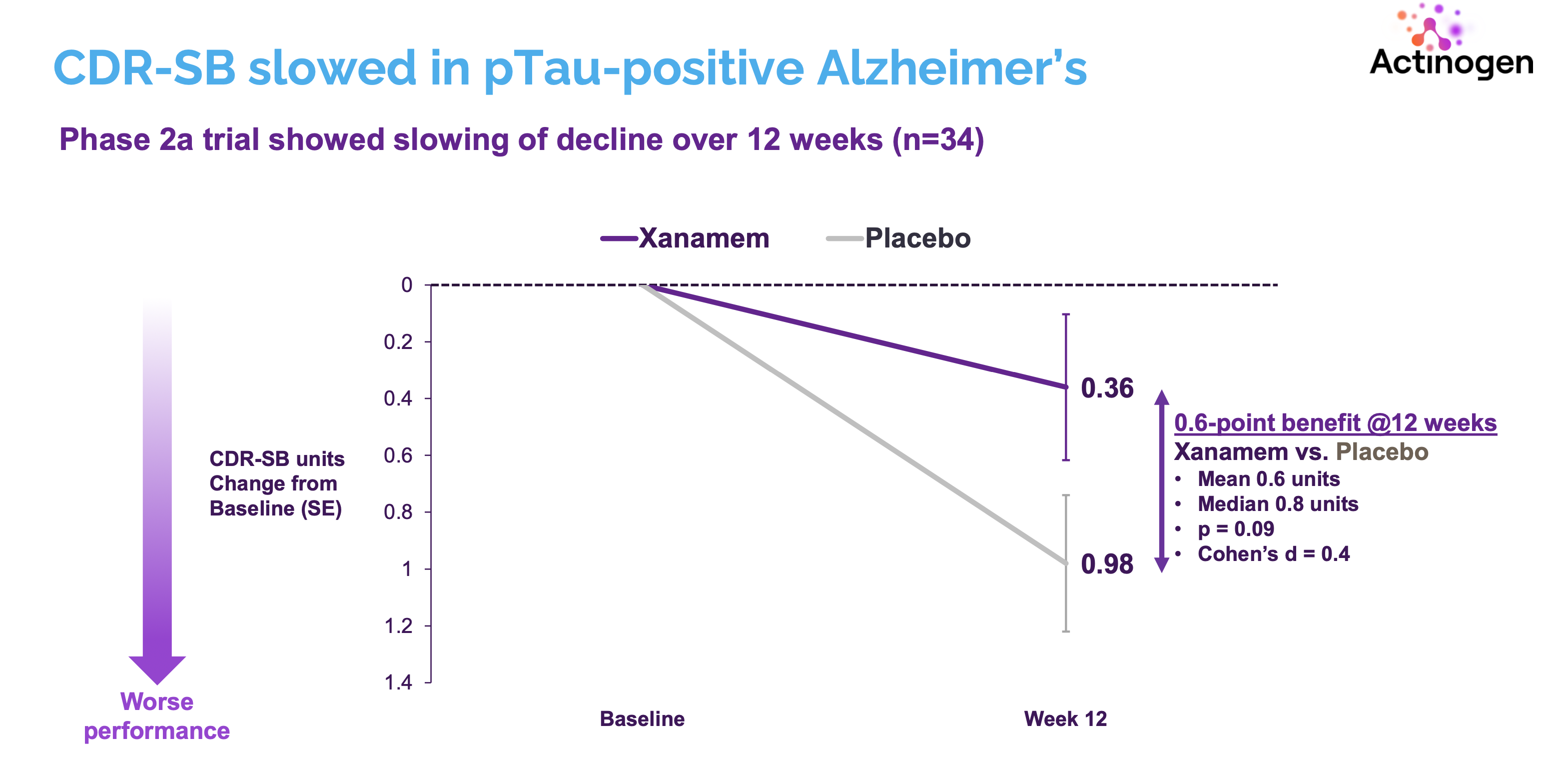
In a subgroup of 34 patients who tested positive for the phosphorylated tau, or pTau, biomarker, Xanamem slowed deterioration on the Clinical Dementia Rating Scale–Sum of Boxes over 12 weeks.
The mean difference between Xanamem and placebo was 0.6 points, with a median difference of 0.8 points. The result did not meet conventional statistical significance, recording a p-value of 0.09, but provided the clinical signal and biomarker-enrichment strategy used to design the larger XanaMIA trial.
Actinogen believes the earlier data suggest Xanamem could potentially produce a greater effect on cognitive and functional decline than therapies that target amyloid alone. That proposition remains to be confirmed by the current study.
XanaMIA fully enrolled
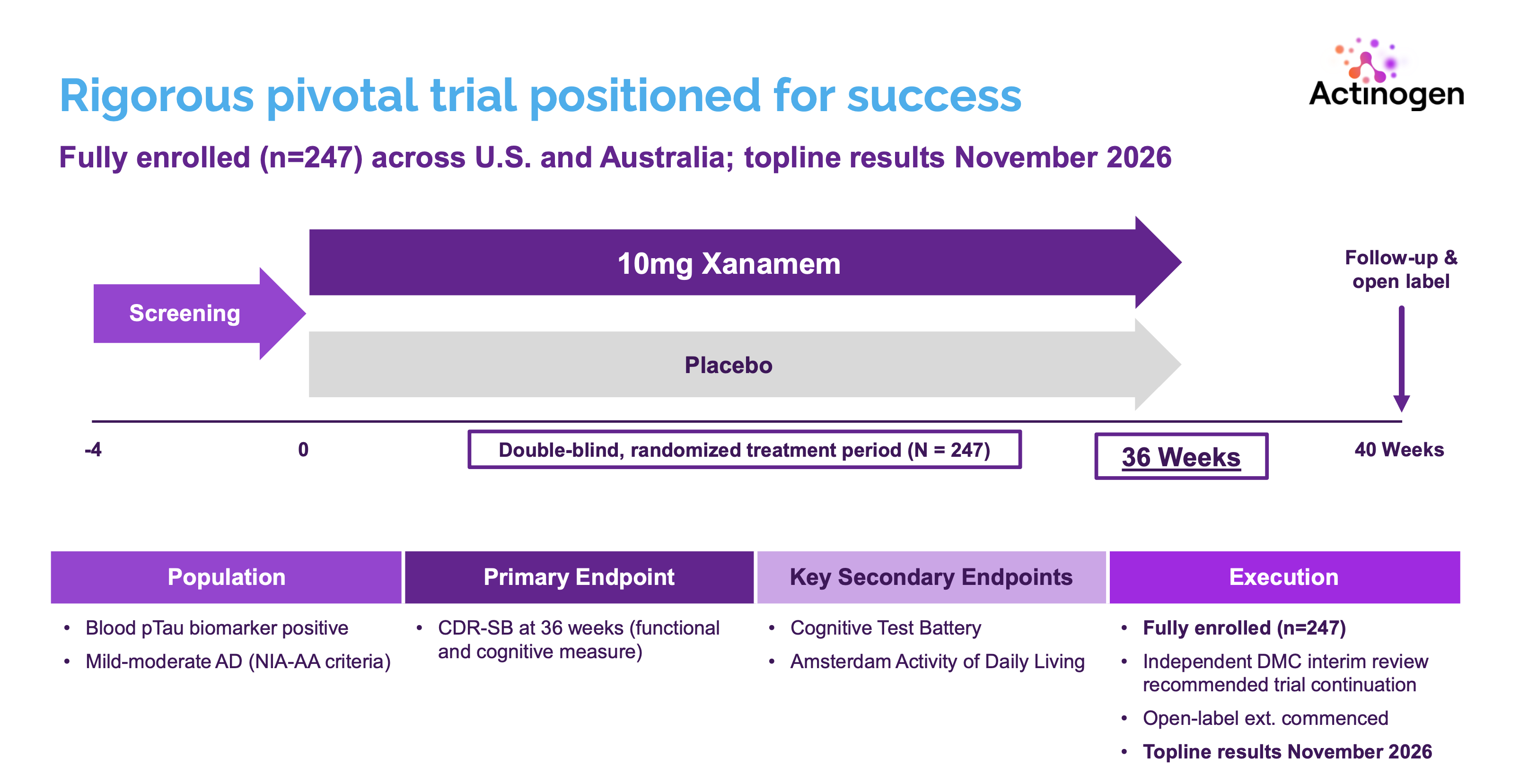
XanaMIA has enrolled 247 participants across the United States and Australia with mild-to-moderate Alzheimer’s disease and a positive blood pTau biomarker.
Participants receive either 10 milligrams of Xanamem or placebo over a 36-week double-blind treatment period.
The primary endpoint is change in CDR-SB, an established measure combining cognitive and functional performance. Secondary measures include a cognitive test battery and the Amsterdam Instrumental Activities of Daily Living questionnaire.
The trial passed an important checkpoint in January 2026 when an independent Data Monitoring Committee reviewed unblinded safety information from all participants and interim efficacy data representing about 37% of the expected final dataset.
The committee recommended that the study continue without modification after assessing safety and whether the trial had become futile. It was not authorised to recommend early stopping for efficacy, preserving the statistical integrity of the final analysis.
The last participant assessment visit is scheduled for September, ahead of topline results in November.
Open-label extension expands safety database
Actinogen commenced an open-label XanaMIA extension in March 2026, offering active 10-milligram Xanamem treatment to participants completing the double-blind study.
More than 80% of eligible participants initially elected to continue.
The extension is expected to provide at least 14 months of additional safety exposure and longer-term information on cognition, daily functioning and the durability of any clinical effect.
It will also allow an observational comparison between participants who began Xanamem during the main trial and those who started after initially receiving placebo.
The resulting data are expected to strengthen the overall safety database and support further regulatory discussions.
Regulatory pathway taking shape
Actinogen has received regulatory guidance from the US Food and Drug Administration and the European Medicines Agency, with engagements taking place in September 2025 and May 2026 respectively.
The company says both regulators aligned with its proposed clinical, manufacturing and supporting study program.
XanaMIA is expected to form a key component of a future registration package. Following positive results, Actinogen expects one additional Phase 3 placebo-controlled study using the 10-milligram dose would be required, alongside open-label safety work and a limited number of clinical pharmacology and non-clinical studies.
Planning for that next pivotal trial is underway, with a potential commencement in mid-2027, most likely alongside a global strategic partner.
Manufacturing and pre-commercialisation activities are also progressing, while supporting studies are scheduled to begin in 2027.
Funded beyond pivotal results
Actinogen says it is funded into 2027, carrying the company beyond the November XanaMIA readout and allowing resources to remain focused on completing the trial and preparing the next development phase.
The company also has intellectual property protection extending well beyond the immediate clinical program. Composition-of-matter protection is expected to run to 2036 in most markets, while additional patents could extend protection into the 2040s.
Management has reported increasing strategic and partnering interest as the pivotal results approach.
The November data will ultimately determine the company’s next direction. A positive outcome could validate brain cortisol as a major therapeutic target, accelerate partnering discussions and move Xanamem into the final stages of development.
A negative or inconclusive result would challenge the program’s clinical rationale and development path.
For now, Actinogen’s position rests on a fully enrolled pivotal trial, a differentiated oral product and a clear regulatory framework — with the company’s most consequential milestone now only months away.